
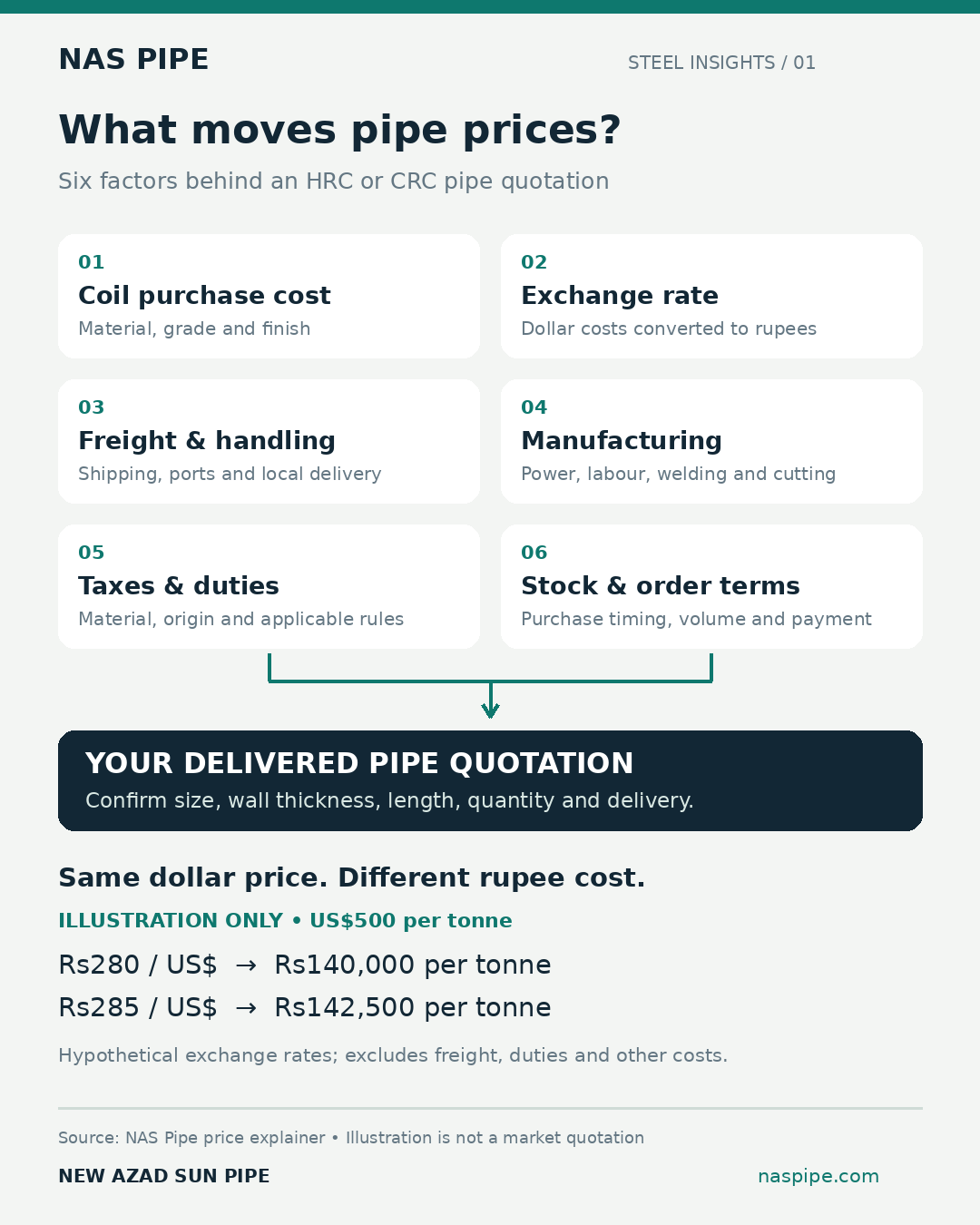
HRC and CRC pipe prices in Pakistan change because the cost of steel, foreign exchange, transport, manufacturing and available stock changes. A pipe quotation reflects several costs—not just the international price of steel.
For buyers in Lahore, Karachi and across Pakistan, understanding these factors helps explain why quotations can differ between suppliers or change between orders.
How Do Coil Prices Affect Steel Pipe Prices?
Steel coil is a major raw material used to manufacture welded MS pipes. Changes in coil purchasing costs can therefore affect the cost of producing round, square and rectangular pipes.
HRC and CRC are also different materials with different processing requirements. Cold rolling, surface finish and thickness tolerances can influence costs, so the two should not be compared on price alone.
International coil prices do not always move in the same direction as the final delivered cost. In its September 2026 quarterly report, Aisha Steel described relatively stable international HRC prices alongside elevated freight and insurance costs.
Why Does the Rupee–Dollar Exchange Rate Matter?
When imported material is purchased in US dollars, its rupee cost depends on the exchange rate. A weaker rupee can increase that cost even when the dollar price remains unchanged.
For illustration only, material priced at US$500 per tonne costs Rs140,000 at an exchange rate of Rs280 per dollar. At Rs285, the same material costs Rs142,500—before freight, duties and other charges. These are hypothetical figures, not current market quotations.
What Other Costs Affect Pipe Prices?
Several costs sit between purchasing coil and delivering finished pipes:
- Freight and handling: Shipping, port handling and inland transport affect delivered costs.
- Manufacturing: Electricity, labour, slitting, welding and cutting contribute to production costs.
- Taxes and duties: The treatment depends on the material, origin and applicable rules.
- Stock availability: Suppliers may hold material purchased at different times and costs.
- Order requirements: Quantity, payment terms and delivery arrangements can affect a quotation.
This also helps explain why a fall in international prices may take time to appear in local quotations.
Why Do Similar-Looking Steel Pipes Have Different Prices?
A similar appearance does not establish an identical specification. Outside dimensions, wall thickness, grade, length and finish all matter.
For the same outside dimensions and length, a thicker-walled pipe contains more steel. Comparing only the price per piece can therefore give a misleading impression of value.
Our View: Compare the Specification Before the Price
At NAS Pipe, we believe a useful quotation should make the material specification and delivery terms clear.
Price movements usually reflect a combination of costs and market conditions. A higher quotation does not automatically indicate excessive pricing, while a lower quotation does not automatically offer better value.
The strongest comparison is between pipes of the same specification, with taxes, quantities and delivery terms clearly understood.
Request an HRC or CRC Pipe Quotation
NAS Pipe supplies HRC and CRC MS pipes from Lahore to customers across Pakistan. Contact our team with your required size, wall thickness, quantity and delivery city for current availability and a quotation.