
Pakistan’s overall steel production can decline while an individual CRC producer increases its output or sales. National statistics cover a broad collection of products and producers, while company results reflect one business’s products, customers and performance.
These figures answer different questions. Understanding that distinction gives buyers a clearer picture of Pakistan’s steel industry.
What Do the Recent Figures Show?
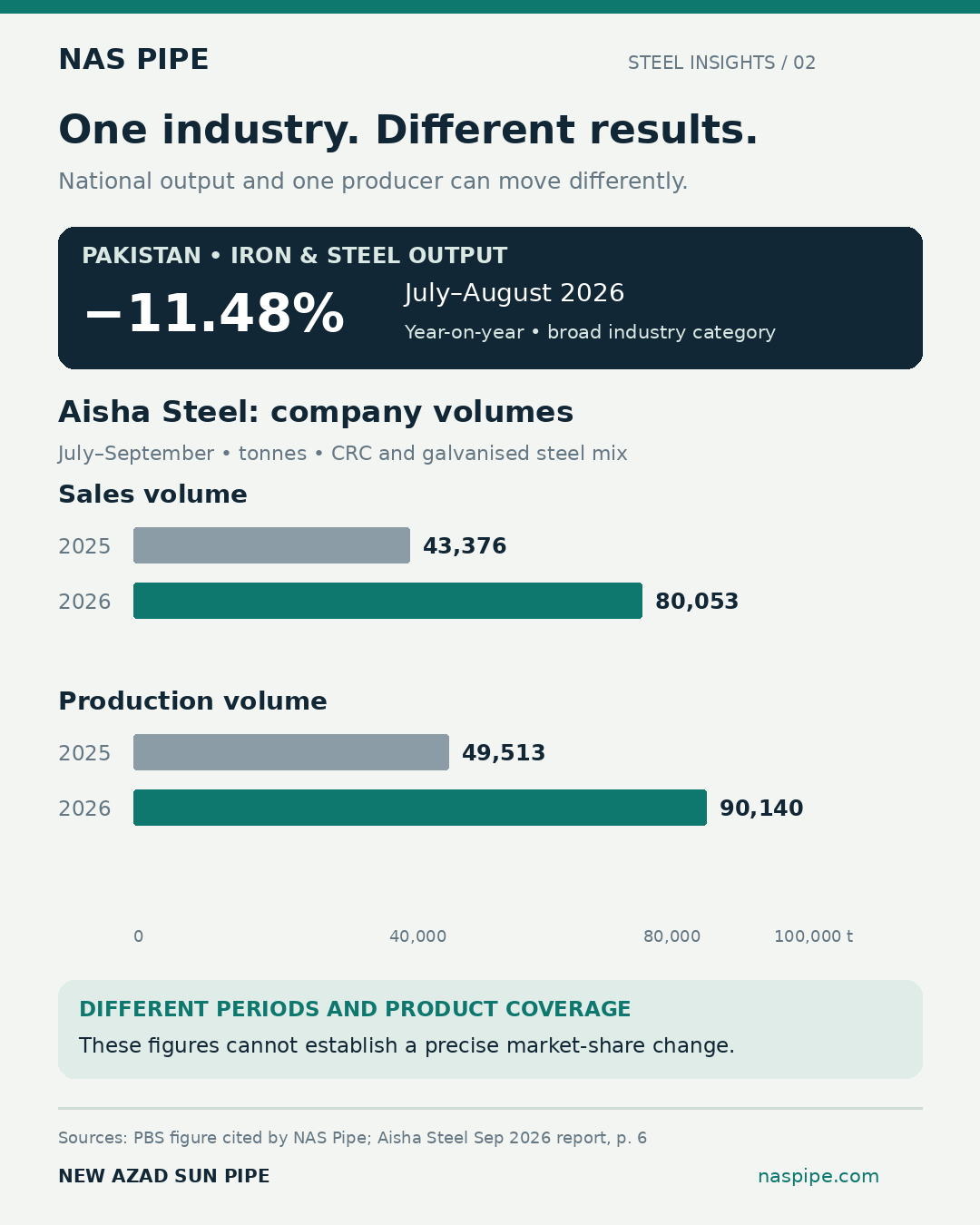
Pakistan Bureau of Statistics reported an 11.48% year-on-year decline in iron and steel output during July–August 2026.
Meanwhile, Aisha Steel, which produces CRC and galvanised steel, reported growth for the quarter ending September 2026:
| Company measure | July–September 2025 | July–September 2026 |
|---|---|---|
| Sales volume | 43,376 tonnes | 80,053 tonnes |
| Production volume | 49,513 tonnes | 90,140 tonnes |
These figures represent approximately 85% growth in sales volume and 82% growth in production, according to the company’s unaudited quarterly report. They cover the company’s reported product mix, rather than CRC alone.
The periods also differ: the national figures cover two months, while the company figures cover three. They should not be used to calculate a precise change in market share.
Why Do Different Steel Products Perform Differently?
Steel is not a single market. Billets, construction steel, hot-rolled products, CRC and coated steel serve different applications.
The manufacturing breakdown reproduced by the State Bank of Pakistan shows this uneven performance. During July–August 2026, billet and ingot production fell 32.48%, while the combined category covering hot- and cold-rolled sheets, strips, coils and plates declined 3.63%. That combined category is broader than CRC.
A sharp decline in one segment can therefore pull the overall index down even when another segment performs better.
How Can Individual Producers Increase Sales?
A company can grow by serving stronger customer segments, winning orders from competitors, replacing imports or expanding exports. Growth does not require every part of the domestic steel market to improve.
Aisha Steel’s management reported stronger demand from automotive and household-appliance manufacturers. Its quarterly export volumes also increased. These are company-specific explanations, rather than proof of a nationwide recovery.
Does Higher Sales Growth Mean the Whole Industry Is Healthy?
No. Sales, production and profitability measure different things. Sales can include stock produced earlier, while profits also depend on costs and other income.
Growth percentages also depend on the comparison period. A large increase from a smaller base should be assessed alongside actual tonnage and longer-term performance.
Our View: Look Beyond the Industry Headline
At NAS Pipe, we believe Pakistan’s steel market should be assessed by product and application, rather than through one headline figure.
A national production decline is a meaningful warning, but it does not mean every manufacturer is shrinking. Equally, strong results from one CRC producer do not establish that the entire industry has recovered.
For pipe buyers and fabricators, the most useful signals remain the availability, quality, specifications and delivered prices of the materials their work requires.
Speak to NAS Pipe
For HRC and CRC MS pipe requirements, contact NAS Pipe with your specifications and delivery location. We supply customers from Lahore across Pakistan.